
Foreign investors have remained cautious ahead of the Union Budget amid expectations of limited policy changes.

Indian benchmark stock indices, Sensex and Nifty, extended their winning streak for a third consecutive day, driven by positive global market trends and a significant softening of crude oil prices following a peace deal between the US and Iran.

The Indian stock market mythos of 36 years is wrapped in a diaphanous negligee, lashed together by a delicate, etheric sash of 1.6 bull markets. To make money from here on will require a ground invasion, trench by trench, rather than carpet bombing. Way more difficult, points out Shankar Sharma.

Indian benchmark indices, Sensex and Nifty, extended their winning streak for a fourth consecutive session, driven by a significant drop in crude oil prices following a peace deal between the US and Iran. This development has fuelled investor confidence and buying activity across the market.

Aviation stocks experienced a significant surge following the announcement of a two-week ceasefire between the US and Iran, which led to a sharp decline in crude oil prices. This development has positively impacted stock markets and the broader economic outlook for India.

From the Sensex firms, State Bank of India, Bajaj Finserv, Bajaj Finance, Maruti, HCL Tech, Larsen & Toubro, Mahindra & Mahindra and Infosys were among the major winners. However, Hindustan Unilever, Eternal, Tata Motors Passenger Vehicles, and Sun Pharma were among the laggards.

Sensex plunges over 1,400 points and Nifty slips near 22,250 amid Trump's Iran threat, rising crude oil prices, and FII selling. Here are the key reasons behind today's market crash.
Indian stock markets rallied in early trade after US President Donald Trump announced a halt to planned military strikes on Iran, citing requests from Gulf leaders and ongoing "very big discussions" that could lead to a deal. This de-escalation, coupled with foreign fund inflows and gains in IT and Adani group stocks, contributed to the positive market sentiment. Track Sensex and Nifty on May 19, 2026.

Benchmark indices Sensex and Nifty closed lower in a highly volatile trade on Thursday amid relentless foreign fund outflows and selling in blue-chip ICICI Bank. Falling for the second day in a row, the 30-share BSE Sensex declined 148.14 points or 0.18 per cent to settle at 83,311.01.

The report notes that equities had faced pressure from elevated valuation premiums, subdued nominal gross domestic product (GDP) and earnings growth, sustained foreign portfolio investor (FPI) selling, artificial intelligence (AI) infrastructure euphoria, and external shocks including US tariffs and a spike in crude oil prices due to geopolitical tensions in West Asia. However, several of these factors are now reversing.

Indian benchmark indices, Sensex and Nifty, closed almost flat in choppy trade as investors remained cautious due to ongoing uncertainty in West Asia, relentless foreign fund outflows, and anticipation of the RBI's monetary policy decision.

The Reserve Bank of India (RBI) on Friday delivered a 25 basis point (bps) repo rate cut analysts expected, driven by the strong 8.2 per cent GDP growth in the September quarter. However, analysts do not expect a runaway market rally as the impact of US tariffs continues.

Indian benchmark indices Sensex and Nifty surged over 1 per cent, with the Sensex jumping 918.60 points, driven by strong buying in banking and financial counters and a positive trend in global equities, fuelled by hopes of easing West Asia tensions.
Indian stock market benchmarks Sensex and Nifty closed higher on Tuesday, buoyed by a drop in crude oil prices, a rally in global markets, and strong buying in IT stocks.

Indian benchmark indices Sensex and Nifty rebounded sharply on Monday, driven by a correction in crude oil prices due to ceasefire efforts in West Asia and strong buying in bank stocks.
Indian equity benchmark indices, Sensex and Nifty, ended marginally lower in a volatile trading session, surrendering early gains due to profit-taking in blue-chip stocks and persistent macroeconomic concerns, despite positive global cues.

Indian benchmark indices Sensex and Nifty experienced a decline due to renewed geopolitical concerns in the Strait of Hormuz, a strained US-Iran ceasefire, and the rupee hitting a record low against the US dollar.

Indian benchmark stock indices, Sensex and Nifty, closed nearly 1 per cent lower following the collapse of US-Iran negotiations, which heightened concerns of a prolonged conflict in West Asia and drove crude oil prices sharply higher.
Indian benchmark indices Sensex and Nifty experienced a significant slump, with the Sensex tumbling 719.08 points, driven by escalating West Asian tensions, a sharp rise in crude oil prices, and a global sell-off in technology stocks.

The reopening of the Strait of Hormuz, following a ceasefire agreement between the US and Iran, is expected to significantly ease India's crude oil supply risks, lower freight costs, and reduce inflationary pressures, as global oil prices have already dropped.
From the 30-Sensex firms, Tata Steel, Kotak Mahindra Bank, Reliance Industries, Axis Bank, Titan and Trent were among the biggest gainers. However, Tata Consultancy Services, Tech Mahindra, Infosys, Bajaj Finance and Sun Pharma, were the laggards.

The remarkable rise of smallcaps reflects the emergence of a broad set of specialised businesses operating in industries where the sectoral tailwinds remain considerably stronger than macroeconomic headwinds, points out Debashis Basu.
Indian benchmark equity indices experienced a significant downturn, with the Sensex plummeting over 800 points and the Nifty falling sharply, driven by rising crude oil prices, geopolitical tensions, and foreign capital outflows.
Indian benchmark equity indices, Sensex and Nifty, rebounded on Wednesday, recovering intraday losses, primarily driven by strong fag-end buying and a significant rally in blue-chip Reliance Industries.
Indian benchmark stock indices, Sensex and Nifty, recorded their fourth consecutive day of declines, driven by selling in FMCG, financial, and auto sectors. The downturn is attributed to fresh tensions in the Middle East, uncertainty surrounding the US-Iran 60-day ceasefire, and elevated crude oil prices.
Indian benchmark equity indices Sensex and Nifty closed higher, recovering from previous losses, driven by a global market rebound, a pause in Israel-Iran hostilities, and a rally in bank stocks.

Indian benchmark equity indices, Sensex and Nifty, ended lower after a five-day rally, with the Sensex dropping 607 points and the Nifty falling to 24,013.10. The decline was primarily driven by heavy selling in IT firms following Accenture's trimmed revenue guidance and renewed geopolitical uncertainty, specifically the postponement of US-Iran negotiations.
Indian stock markets saw a significant rebound, with the Sensex jumping nearly 790 points, primarily fuelled by strong buying interest in telecom, pharma, and private banking shares, despite a volatile trading session and a weakening rupee.

Rajesh Mehta, Chairman of Rajesh Exports, has distanced his firm from LIC's investment decisions, stating, "We don't even know where LIC's office is. We have no contact, no connection. This decision of buying shares through the secondary market is their own decision in a prudent commercial manner."
Indian equity markets experienced a significant downturn as geopolitical tensions in West Asia, rising oil prices, and foreign fund outflows dampened investor confidence. The Sensex and Nifty both fell sharply in early trade, reflecting broader global market weakness.

Accenture's revised annual revenue growth forecast and weaker-than-expected fourth-quarter guidance have sent shockwaves through the Indian IT sector, causing major IT stocks and the Nifty IT index to tumble significantly.

Among Sensex firms, Eternal, Infosys, Asian Paints, HDFC Bank, Bajaj Finserv and Titan were the major gainers. However, Tata Steel, Tech Mahindra, Adani Ports and Bharat Electronics were among the laggards.
Indian stock markets recovered from early losses to close higher, driven by value buying in IT and banking shares and a rebound in the rupee.
Indian benchmark indices, the BSE Sensex and NSE Nifty, snapped a four-day losing streak, with the Sensex climbing 382 points, primarily driven by a strong rally in IT sector shares. Major IT firms like TCS, Infosys, and HCL Tech saw significant gains, contributing to the market's recovery.
Sensex gains over 400 points while Nifty trades above 23,800 amid strong IT sector buying.
Indian equity benchmark indices Sensex and Nifty closed lower on Thursday, driven by escalating tensions between the US and Iran, persistent foreign fund outflows, and concerns over rising US inflation.
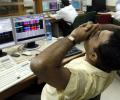
Indian benchmark indices Sensex and Nifty experienced a sharp decline in early trading due to escalating tensions in the Middle East, driving crude oil prices higher. Global market bearishness and foreign fund outflows further contributed to investor unease.

A potential US-Iran peace deal, expected to be signed on June 19, is anticipated to ease geopolitical stress and benefit various sectors, particularly in India, with analysts suggesting investors await finer details before making significant moves.
Indian benchmark equity indices, Sensex and Nifty, rebounded nearly 1 per cent, with the Sensex jumping 790.54 points to 76,991.22, driven by softening crude oil prices and strong buying in banking, financial, and IT shares.

Indian benchmark stock indices Sensex and Nifty rallied for the second consecutive day, closing nearly 1 per cent higher, driven by gains in metal and auto sectors and positive global market trends.
